
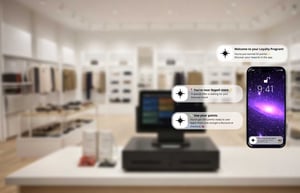
We’ve all been there: a customer stands at the checkout, the queue is growing, and the "simple" process of scanning a loyalty card becomes a clunky, multi-step negotiation. Most retailers start their loyalty schemes with the best intentions, but somewhere between the marketing plan and the shop floor, the magic gets lost in the friction.
I promise you this: a loyalty programme shouldn't feel like a chore for your staff or a hurdle for your customers. It should be the invisible engine that turns a one-off transaction into a lifelong relationship.
Today, I’m breaking down the technical playbook for integrating Shopify POS and digital wallets to make rewards feel like a habit, not a task.
The "Friction Gap": Why Programmes Fail in the Real World
Loyalty schemes usually fail not because of a lack of interest, but because they are designed as "parallel ecosystems." They exist beside the sale rather than within it. When checkout and loyalty don't flow together, three things happen that kill ROI:
- The Recognition Barrier: If a customer has to explain themselves ("I have points," "I’m a member"), the system has already failed.
- Redemption Hurdles: If using a reward interrupts the conversion or adds three extra steps for the cashier, it becomes a "nuisance" rather than a benefit.
- The Data Void: Without real-time integration, your data just sits there untapped. You aren't driving personalisation; you're just collecting names.
In modern retail, the checkout isn't the end of a sale, it’s where the actual relationship begins.
Loyalty: From a "Marketing Project" to a "Sales Behaviour"
In 2026, the most successful retailers treat loyalty as an operational sales lever. You can spot a failing programme by the signals: lots of sign-ups but zero usage, rewards that arrive too late via email, and staff who skip the "loyalty talk" because it’s too slow during a rush.
To fix this, we have to look at the concrete reality of the shop floor. We need to ask:
- How easy is it to use the points at the till versus online?
- Do the store and eCommerce share the same rules and balances?
- Is the experience consistent, or are you forcing the customer to explain their history to you?
When loyalty is integrated into the sales flow, it becomes a repeated behaviour: recognition, clear benefit, immediate use, and cross-channel continuity.
Mobile-First Without the App: The "Wallet" Revolution
Let’s be honest: asking a customer to download another app is a massive obstacle. Loyalty lives on repeated gestures, not intentions. This is why Apple Wallet and Google Wallet are the ultimate operational shortcuts.
By moving the loyalty card into the customer's phone wallet, you remove the "micro-negotiation" at the till.
- Instant Scanning: No searching through emails or typing in phone numbers.
- Contextual Triggers: Automatic card updates (balances, tiers, unlocked rewards) work better than generic emails because they arrive when they make sense—right when the customer is near your store.
- Data that Decides: When a card is scanned in-store via a digital wallet, you start measuring real signals like effective redemption and response to triggers. This is data that helps you make business decisions, not just tell a marketing story.
The Technical Architecture: Syncing Shopify POS with Digital Wallets
How do we actually make this "fluidity" happen? Here is the roadmap for building a frictionless loyalty setup:
1. The Single Source of Truth
The loyalty engine (like LoyaltyLion or Smile.io) must be natively integrated with the core Shopify database. This ensures that $1$ point earned online is visible $1$ second later on the Shopify POS at your physical location.
2. Enable "Add to Wallet" Triggers
Don't wait for the customer to find the card. Set up post-purchase triggers on the Order Confirmation Page and via dynamic links in post-purchase emails to push a personalised pass directly to their phone.
3. Configure Dynamic Pass Updates
A digital wallet pass should be dynamic. Use API hooks to ensure that when a customer’s "Tier" changes (e.g., from Bronze to Gold), the branding of the digital card changes automatically in their phone. This provides immediate visual gratification.
The Architecture of a Connected Sales Flow
The hardest part of loyalty isn't the launch; it’s avoiding the "Disconnected World" problem. This happens when your Shopify POS, eCommerce, and loyalty engine aren't sharing a real-time database.
When we design these flows, we focus on Three Pillars of Operational Fluidity:
- For the Staff (Unified UI): By pulling loyalty data directly into the Shopify POS smart grid, staff don't have to leave the checkout screen to check points. It’s one interface, one tap, zero extra training.
- For the Customer (Real-Time Sync): The system uses a single customer ID across all channels. If a customer earns points on their phone while standing in the queue, those points are available to spend by the time they reach the till.
- For the Business (The Trigger Engine): Integration allows for automated rules. If a customer hasn't visited a physical store in 30 days, the system can auto-push a contextual reward to their Apple Wallet to drive footfall.
Your 3-Step Loyalty Audit
If you want to know where to intervene, start with the real-world flow.
| Stage | The Logic Test |
|
The Online Checkout |
Does the customer see their benefits while buying, or only after? |
|
The Physical Till |
How many steps does the staff take to apply a reward? If it's more than two, it’s too many. |
|
The Communication |
Is your messaging broadcasting to everyone, or is it contextual (e.g., "You're £10 away from your next reward")? |
From First Purchase to Lasting Relationship
True growth isn't in the first order. It’s in the second and third time your customer chooses you without needing a discount to be lured back. That choice comes from an experience that makes repetition feel natural.
Fluidity isn't just a concept; it’s a measurable KPI. You see it in faster checkout times, higher redemption rates, and purchase frequency. When the story is unique and the system works, the experience doesn't need to be explained, it’s felt.
The final question is simple: Does your loyalty exist alongside your sales, or is it a natural part of how you sell?