

Day 1 of NRF 2026 at the Javits Centre in New York highlighted a truth that has become impossible to ignore: today, retailer growth is stalled more by technology than by the market itself.
Three recurring frictions emerged, common across brands of varying sizes and sectors: fragmented commerce, complex tech stacks laden with technical debt, and operations struggling to keep pace. If you work in retail, this likely sounds familiar.
Current technological architecture is often still built as a tangled web of integrations between disparate systems. Over time, this model has become not only costly to maintain but the primary obstacle to growth.
Juggling separate platforms for inventory, orders, and customers breeds operational uncertainty, pricing discrepancies, and inconsistent promotions across channels. The result? A frustrating experience for both internal teams and customers.

How do we dismantle this complexity? During the first day of NRF ’26, Maxime Moyson and Tanya Nam from Shopify (you can view the full agenda here) demonstrated why unified commerce represents the most concrete approach to reducing technical debt and restoring speed to retail organisations.
The Cost of Integrations and the "Frankenstein Ecosystem"
Many companies end up managing technology rather than selling products. This isn't due to a lack of skills, but because they have built "Frankenstein" architectures where every piece of data (product, inventory, customer) must be continuously synced between different systems.
A prime example is "buy online, pick up in store" (BOPIS).
In a fragmented environment, implementing and testing this service can take over a year of work, often at the expense of holidays, weekends, and IT team morale.
This approach is not just expensive; it drains invisible but crucial resources:
- Data silos: In-store staff lack access to a customer's online purchase history.
- Technical debt: Developers spend their time maintaining integrations instead of creating new experiences.
- Fragmented experience: Inventory and promotions do not match across channels, undermining consumer trust.
Real-time Inventory as the "Single Source of Truth"
Unified commerce flips this logic. Instead of syncing data between silos, a single operating system like Shopify collects and connects information across products, customers, physical stores, eCommerce, B2B, marketplaces, and social channels.
For a retailer with multiple locations (stores, warehouses, outlets) this means relying on a single source of truth in real time, delivering immediate benefits:
- Empowered staff: Sales associates know instantly what is available anywhere, guiding the customer more effectively.
- Flexible fulfillment: Ship from the nearest location or fulfill online orders from the store during low footfall periods, optimising costs and resources.
- Intelligent stock management: Transfers between locations and price differentiation become simple configurations rather than development projects.
Shopify POS and The Power of Shared Data
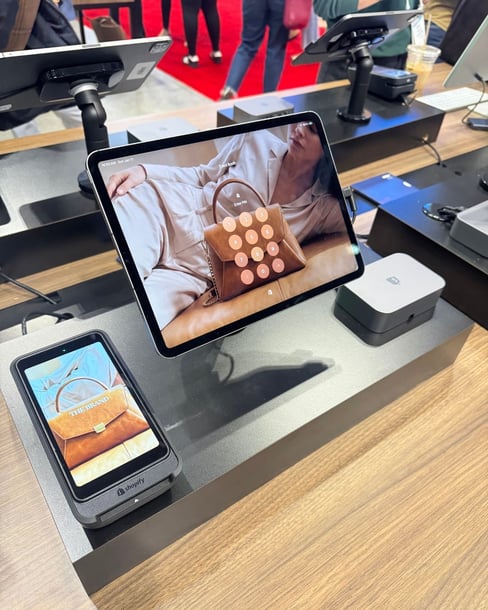
Shopify doesn't add complexity; it eliminates it. Fewer technological layers mean up to 25% lower maintenance costs and an 89% reduction in reliance on third-party support, with a positive impact on Customer Lifetime Value (LTV).
One of the most transformative elements is undoubtedly the Shopify Payments effect.
Thanks to a base of hundreds of millions of shoppers already in the system, a customer can be recognised in-store simply via their credit card, even if they have never purchased at that specific location before.
This enables scenarios that were previously complex to execute:
- Genuine personalisation: Staff recognise the customer, know if they are a VIP, and understand their preferences.
- Unified promotions: Consistent pricing and offers online and offline, with no discrepancies at the till.
- Localised targeting: Geographic proximity segments allow you to attract physical customers with relevant messaging.
The Era of the AI Agent with Shopify Sidekick
When data is unified, Artificial Intelligence finally becomes truly applicable. Have you heard of Shopify Sidekick? It is an AI agent capable of answering complex strategic questions for both the CTO and your marketing team.
In practice, Sidekick can:
- Analyse data and performance, providing immediate insights based on roles and permissions.
- Support creativity and content, generating images and copy from a simple description.
- Create and automate, producing resources, managing configurations, and even suggesting code drafts.
Remember, successful brands don't need to become tech companies. However, they must commit to reducing technical complexity to focus on what truly matters: serving their customers better.
The data confirms this.
A customer who shops both online and offline has a Lifetime Value (LTV) more than 11% higher than one who uses a single channel.
The real question today isn't whether unified commerce is the future, but whether your company is ready to stop "reinventing the wheel" and start building on simpler, more solid, and scalable foundations.