

The Shopify Winter Edition is one of those moments that redefines industry conversations. Not just because it introduces new features, but because every year it clearly signals where the core of global commerce is shifting.
This Winter ’26 Edition has raised the bar. Shopify has built a powerful narrative, choosing the theme RenAIssance as a turning point for progress and transformation.
Artificial intelligence here is the keystone. It is no longer an add-on, but a structural component of the platform, woven into the fabric of the over 150 features presented.
And here is the part that truly matters. What does this mean for those already using Shopify? Greater operational speed, reduced complexity, and more fluid processes across data, channels, and operations: from catalogue optimisation to daily management and decision support.
And for those considering a migration to Shopify? An increasingly "AI-native" ecosystem, designed to reduce dependency on external tools while boosting team productivity, scalability, and control.
The Evolution of Discovery: From SEO Optimisation to AI Visibility

Today, people no longer just "search"; they ask. They ask ChatGPT, they ask an AI agent. They don’t want ten blue links; they want a comparison, a recommendation, a pre-filtered selection.
This radically changes the discovery of new products and services. It no longer happens solely on the SERP (Search Engine Results Page), but within a conversation. And in that conversation, the winners are the brands whose catalogues are machine-readable before they are persuasive to humans.
With Agentic Storefronts, Shopify integrates store catalogues directly into chatbot conversations and AI shopping platforms. This isn’t an app; it’s a platform capability that enables new ways to discover and purchase products via AI agents, relying on structured and controllable data.
For retail, especially for those managing complex catalogues involving variants, materials, sizes, availability, and intricate assortments this is a pivotal shift.
Shopify Winter Edition ’26 reminds us how to stay competitive: those with a tidy catalogue will be favoured; those with fragile structures will be excluded without even realising it. Thus, product data quality ceases to be a technical issue and becomes a growth lever, because artificial intelligence doesn't read storytelling. It reads attributes, consistency, and structure.
Sidekick Pulse and the new role of operational intelligence

If product discovery has already changed, the way teams interpret data must change too.
Unexpected spikes, products picking up speed, stock disappearing, conversion rates shifting before you can understand why… The problem for retailers isn't a lack of data, but the difficulty in rapidly transforming it into decisions.
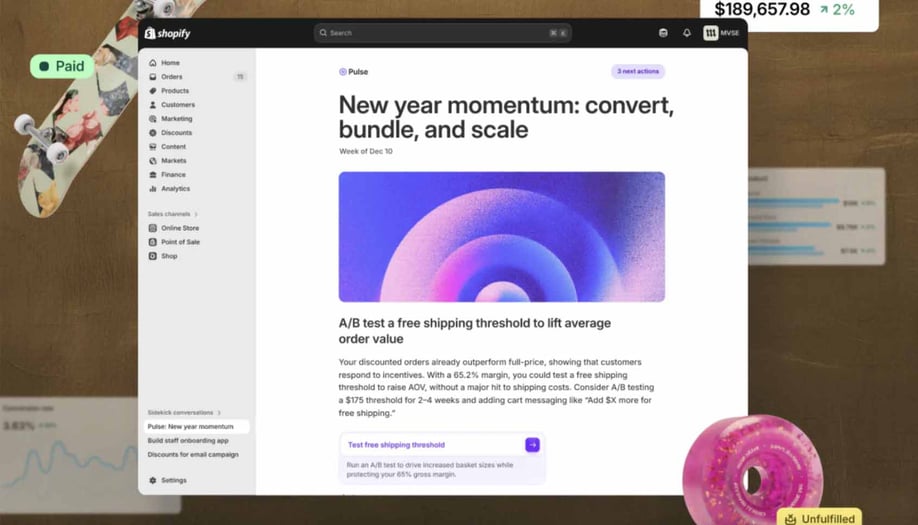
Sidekick Pulse was born for this exact need. It isn’t an assistant waiting for input, but an analytical engine that observes your business signals, interprets patterns, and proposes concrete actions.
Examples? Anticipating a drop in conversion, reading traffic anomalies, identifying a trending product, or spotting a fragility in the supply chain before it becomes a problem.
The strength of Sidekick Pulse doesn't lie in its ability to provide answers, but in guiding your attention towards what truly matters. However, as always with AI, the quality of recommendations depends directly on the quality of the data. Pulse works if your store is organised, if inventories are consistent, if products are mapped correctly, and if categories are logical with well-defined variants.
Remember: AI cannot compensate for a fragile structure; it can only amplify it.
POS Hub: Retail is no longer a digital afterthought
Winter ’26 pushes physical retail towards enterprise standards, designed for multi-store environments and structured operations.
With POS Hub, Shopify introduces a hardware foundation designed for complex operations: remote management, centralised diagnostics, compatibility with traditional peripherals, and greater stability.
For those managing daily store operations, the message is clear: Shopify is building an enterprise experience without dragging you back into the world of rigid, slow, and expensive legacy systems.
The real value isn't the device itself, but the ability to manage physical stores, eCommerce, Marketplaces, and social commerce within the same ecosystem. Inventory, customer profiles, returns, checkouts, and data finally stop running on two (or more) separate tracks.
Rollouts: Continuous optimisation becomes part of the job

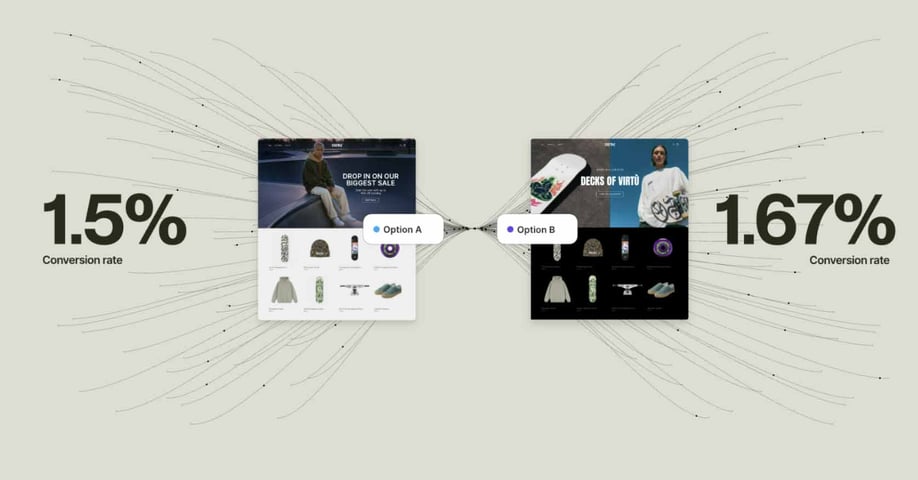
Anyone working in this sector knows that every change is a trade-off: speed vs. risk, innovation vs. stability. With Rollouts, Shopify makes optimisation a continuous, plannable, measurable, and repeatable process. You can test variants, schedule changes, compare versions, and automatically apply the winner.
Brands can now schedule the activation of a new interface, test layout variants, compare two versions of a product page, or execute a launch with precise timing automatically applying the winning versions.
Rollouts speeds up testing and reduces errors, bringing an approach to commerce that is closer to product teams than to traditional processes.
In short: fewer one-off interventions, more culture of iteration, just like a true product team. Technical complexity gives way to the capacity for rapid adaptation. In a market where habits change in weeks, this isn't just a convenience; it is a significant competitive defence.
Shopify Winter Edition ’26: Order, quality, and consistency
As you can see, RenAIssance is not a collection of isolated features; it is a direction:
- Discovery becomes agentic, clean data is key.
- Analytics become proactive, consistent inventories are required.
- Retail becomes structured, integrated processes are essential.
- Optimisation becomes continuous, governance is non-negotiable.
The message is simple, and for those working in retail, it is also liberating: growth in 2026 won’t depend on how fast you run. It will depend on how solid you are while running.

Turn the Shopify Winter Edition ’26 into an operational advantage
At power2Cloud, we see this dynamic every day. Features make no difference if the data isn't ready, if processes aren't integrated, or if the architecture can't hold up.
That is why we work with brands to build solid foundations: structured catalogues, inventory governance, integration between retail and eCommerce, clean measurement, and automations that truly free up the team.
Shopify Winter Edition ’26 offers concrete opportunities, but it requires method. Growth will go to those who can transform this release into a daily discipline. The power2Cloud team is ready to guide you.